
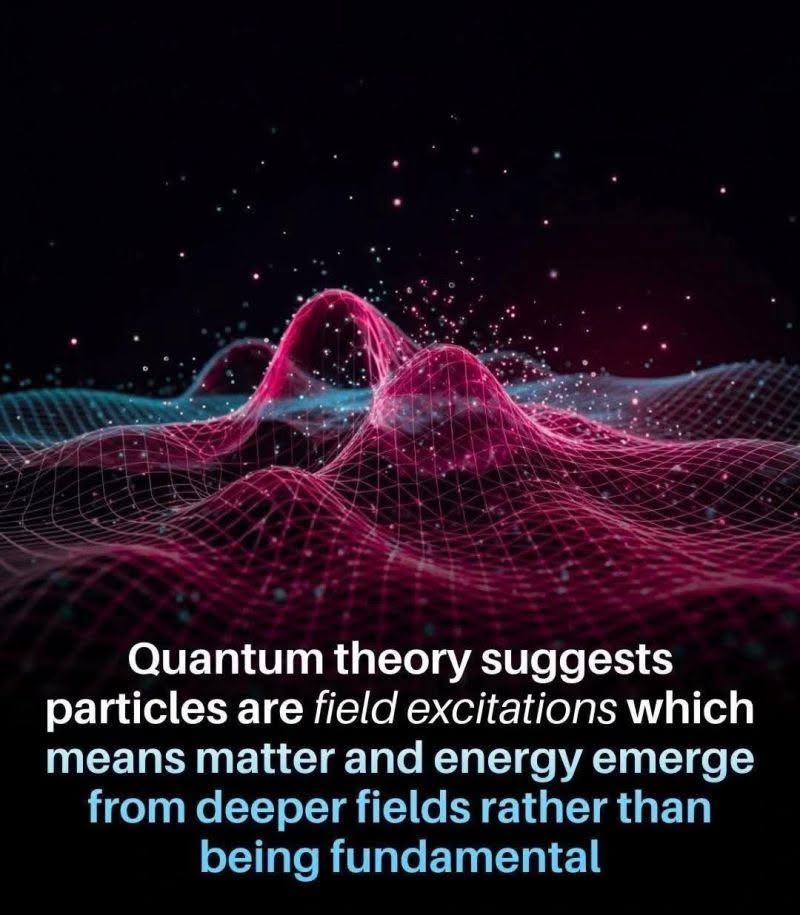
Modern physics has already overturned the old idea that matter is made of tiny, solid building blocks. In quantum field theory, particles are understood as excitations of underlying fields that exist everywhere in space. An electron is a localized vibration of the electron field. A photon is a ripple in the electromagnetic field. These are not metaphors. This framework has been confirmed by decades of experiments and is one of the most accurate predictive systems ever developed.
What is known is this: fields are fundamental to our current understanding of nature, and particles arise from them. Even empty space is not empty. Vacuum fluctuations, measurable forces like the Casimir effect, and subtle shifts in atomic energy levels all reveal that fields persist even in the absence of matter.
What remains theoretical is what lies beneath these fields. Physics does not yet know whether quantum fields themselves are the final layer of reality or whether they emerge from something deeper. Leading research in quantum gravity, holography, and spacetime geometry suggests that fields, space, and time may arise from more fundamental structures, but direct experimental confirmation has not yet arrived.
This leaves us with a profound and open question. If matter emerges from fields, and fields may emerge from something deeper, what is the ultimate source field from which all structure arises? Is it geometric, informational, relational, or something not yet fully imagined?
Science has shown us that reality is not built from objects but from patterns of activity. The deeper we look, the more the universe reveals itself as a continuous unfolding rather than a collection of things.
The final answer has not yet been found. But the direction is clear. The foundations of reality are quieter, deeper, and more unified than once believed.